
Unconventional Secretion
In recent years, my research program has focused on the mechanism of unconventional secretion of proteins of physiologic interest such as IL-1 beta (8) and FABP4 (9). Most recently, we have become interested in the spread of α-synuclein (α-syn)
Current effort on α-syn, a protein genetically implicated in Parkinson’s Disease (PD), is focused on how this soluble, relatively unstructured protein may be translocated across a membrane without a typical signal peptide. Alpha synuclein is a major constituent of Lewy Body particles that appear in the dopaminergic neurons in patients who have died of PD. One question is how synuclein may progress out of dopaminergic neurons, in a midbrain tissue called the substantia nigra, into other areas of the brain as may happen in the spread of dementia in some patients with PD. Three different avenues of such intercellular movement are possible: secretion of soluble monomer or oligomer and endocytic reuptake by neighboring cells followed by cytoplasmic penetration to engage the intracellular pool of α- synuclein and another cycle of unconventional secretion; capture of α-synuclein into exosomes that form by budding of vesicles into an endosome followed by secretion of vesicles, endocytic reuptake and cytoplasmic penetration; transmission through intercellular tubular connections, sometimes called tunneling nanotubes, that permit cytoplasmic forms of synuclein monomer or oligomer to spread independent of a membrane penetration event.
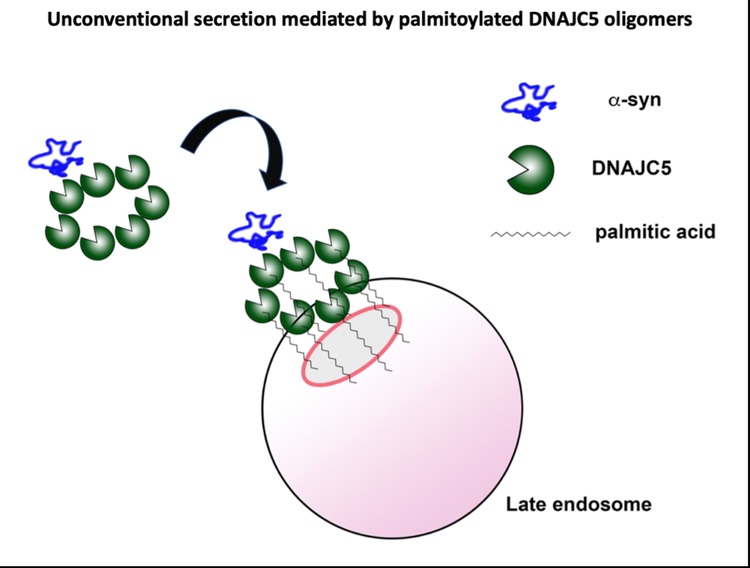
In studies using a standard human cell line, HEK293, and with differentiated mouse and human dopaminergic neurons, we found that α-syn is secreted into the growth medium as a soluble monomeric protein, not enclosed in extracellular vesicles. The membrane translocation event appears to involve capture of α-syn into the interior of an endosome in a reaction that requires a palmitoylated form of a membrane anchored DNAJC5 protein (10). The nature of this membrane translocation event remains unknown. It may occur directly across the endosomal membrane or may require the internalization of a complex of α -syn bound to membrane tethered DNAJC5 segregated into exosomes within the endosome. We find that α-synuclein fused to a protein designed to resist unfolding remains competent for secretion, thus a translocation channel would have to be unusually large and flexible, or the process must involve some possibly membrane rupturing event that may occur at the moment of internalization of a vesicle budding into the endosome.